Costa Rica
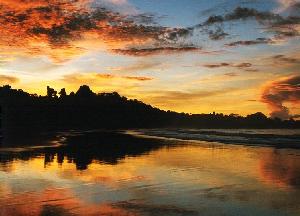 While at Cahuita, we stopped in to see the National Park. As we were driving in, a coatimundi (a large animal that looks kind of like a cat with a very long tail sticking straight up into the air behind it) ran across the road. On the trails, we saw a huge iguana, maybe four or five feet long. Later in our trip, we discovered that was not uncommon. We saw so many hundreds of iguana they became quite commonplace. When we made it out to the beach, we were amazed. Here was a beach, miles long, that epitomized the “paradise” type beaches you find in movies such as The Blue Lagoon, yet we were the only people in view. Throughout the trip, we kept running into these amazing, “Garden of Eden” type beaches, but they were almost always empty. Talk about paradise! Read more…
Trekking in Norway
(by Joyce Audy Zarins)
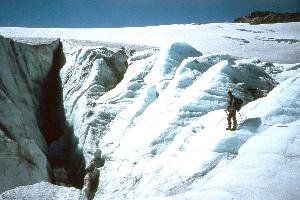 We went up with Torger in the lead probing with his ice ax for crevasses hidden under the snow. Since the weather had been unusually warm there was running water in places, pouring down into potholes three or four feet across and which fell the entire depth of the glacier. These were holes to look, but not fall, into. The other primary hazard is of course the crevasses, some of which are very obvious, whereas others are camouflaged by snow. The ice of the crevasses really is blue as is written. The surface of the glacier was irregular and grainy or slushy in some places, hard in others. Crampons were certainly needed. As we trudged, small dark spots littered the ice here and there – tiny clumps of decomposing fur and bone that used to be lemmings. A few years back the remains of a German soldier who died on the glacier during WWII was extruded out the side by the compression of the ice. On the way down we passed a monument to others who died up there. Read more…
Germany, Luxemburg, and Austria
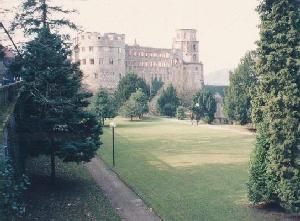 Our dining experiences were some of the most enjoyable times we had in Germany. We decided early in the trip to spend a while each day searching out The Place. We defined The Place as the most authentic, most German restaurant possible. This meant that most of the time we walked for an hour or two far outside places normally traveled by tourists, searching side alleys for an out-of-the-way, obscure little sign indicating an eating establishment. This was extremely effective, and we had some of the best food and service we have ever had. Even in Heidelberg, a completely touristy city, we found The Place. It was a tiny little place in the second story of a building halfway down an alley. Its name is The Schnitzelbank. All of the other customers were German. The service was good, and the food was awesome. Another time, we pulled off the Autobahn (highway) in the middle of nowhere. We drove several kilometers away from the Autobahn and found a little, tiny town. In that town we found a small bar/restaurant. Inside, there was a man serving drinks to his friends at the bar. It turned out that he was the bartender, the waiter, the cook, the busboy, and the owner all rolled into one. Even though he was completely alone, every time a glass was empty he was there asking us if we wanted another drink. Since this was deep in southern Germany, his dialect was thick enough that we had trouble understanding him, but we muddled through. The service was great and the food was very good. After dinner, the owner came back and asked us why we were in the area. He asked if we were working somewhere nearby. He just couldn’t quite understand why three Americans would be sitting in his tiny restaurant in his tiny town! Read more…
Adventure Trips
(by Lucy Monahan)
If you want to see the world but can’t afford it or can’t find someone to go, you should try going with an overland group. There are several companies that offer such trips….a few names would be Encounter Overland, Guerba (who specialises mostly in Africa), Encounter, or Exodus. All of the companies offer trips to various parts of the world, mostly no frills. There’s another company called Trek America that does camping trips in the U.S. (and maybe Canada?) too. Read more…
Annapurna Trek in Nepal
(by Al Maxwell)
We set out in the back of a Chinese truck to Birithanti (elevation ~3000′) where we picked up the trail. This “trail” is actually the major trade route between India and Tibet, and is often paved with stone and includes stone stairs on the steeper pitches. This makes it easier for the many porters, donkeys, horses, bulls, and yaks that carry the cargo. After a great Dahl Baht (Rice and Lentils) lunch, we set off for Gorepani (Horse Water) but didn’t make it that day. We stayed in a small guest house, had a great Dahl Baht dinner, and went to sleep thinking of our destination, Muktinath, the Buddhist/Hindu pilgrimage temple at 13,000′, which would take 9 more days to reach. Read more…
The San Francisco Motorcycle Adventure of a Lifetime
(by Brian Rutherford)
The city of San Francisco is one of the best places to go sightseeing and meet people. I was there five years ago, so when I had the chance to go back, I took it immediately. From the downtown area, to the world famous Golden Gate Bridge, to the Marin highlands, the motorcycle ride around San Fran area was an incredible journey.

